The Slack Paradox: Why Efficiency is the Enemy of Resilience in 2026
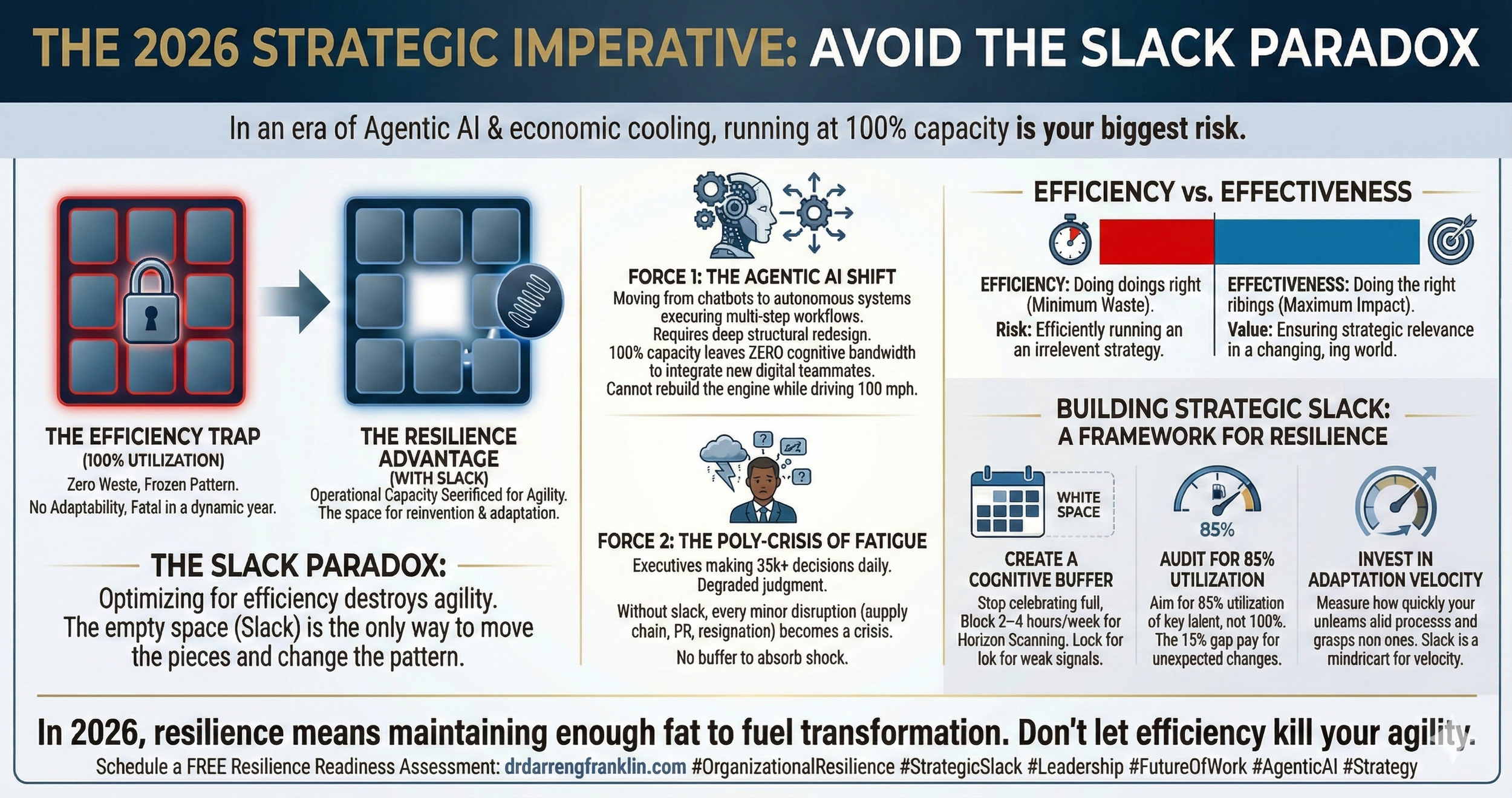
In a year defined by Agentic AI and economic cooling, the most dangerous thing you can do is run your organization at 100% capacity.
As we look ahead to this new year, the instinct in boardrooms is the same: Tighten.
The economic forecasts are predicting sturdy but modest growth, hovering around 2%. Capital costs remain elevated. The natural reaction to this environment is to optimize—to strip away the fat, maximize utilization rates, and ensure every dollar and every minute is accounted for. We call this efficiency.
But my research into organizational resilience suggests that in the specific operating environment of 2026, this obsession with efficiency is a strategic error. By optimizing for efficiency, we are inadvertently destroying our capacity for agility. This is the Slack Paradox.
To understand why, we have to look back at a concept introduced by Tom DeMarco decades ago. He compared an organization to those sliding tile puzzles we played with as kids—the ones with eight numbered tiles in a nine-slot grid. To solve the puzzle, you slide the tiles around. But you can only move the tiles because there is one space—the slack. If you were to optimize that puzzle for efficiency by filling the ninth slot with a tile, you would have 100% utilization. You would have zero waste. But the puzzle would be frozen. You could never change the pattern. You would be locked in.
In 2026, many organizations are operating like a jigsaw puzzle with all the pieces in place. They are 100% efficient and 0% adaptable.
Why is this fatal right now? Because 2026 is not a static year. It is a year of structural upheaval driven by two massive forces:
The Agentic AI Shift. We are moving from generative chatbots to Agentic AI—systems that autonomously plan and execute multi-step workflows. Integrating these agents isnt a plug-and-play upgrade; it requires deep structural redesign of how work gets done. If your human managers are running at 100% capacity handling day-to-day operations, they have zero cognitive bandwidth to govern, train, or integrate these new digital teammates. You cannot rebuild the engine while driving at 100 mph.
The Poly-Crisis of Fatigue: Decision fatigue is real. Executives are making upwards of 35,000 decisions a day, and the cognitive load is degrading judgment accuracy. When an organization lacks slack, every minor disruption—a supply chain hiccup, a PR issue, a resignation—becomes a crisis because there is no buffer to absorb the shock—efficiency vs. effectiveness.
We must distinguish between two words we often use interchangeably: Efficiency is doing things right (minimum waste). Effectiveness is doing the right things (maximum impact). You can be highly efficient at doing the wrong thing. In fact, as we automate more tasks in 2026, the risk of efficiently running a strategy that is no longer relevant is higher than ever.
Slack represents operational capacity sacrificed in the interests of long-term health. It is the time when reinvention happens. It is the white space on the calendar that allows a leader to spot a weak signal in donor behavior or market trends before it becomes a crisis.
So, how do we build slack into a P&L that demands performance?
Create a Cognitive Buffer. Stop celebrating full calendars. A calendar that is 100% booked is a sign of a router, not a leader. Block out 2–4 hours per week for Horizon Scanning—looking at data that isn't screaming yet, but is whispering about the future.
Audit for 85% Utilization. Aim for 85% utilization of your key talent, not 100%. That 15% gap is your surge capacity. It is the buffer that allows your team to handle unexpected regulatory changes or AI hallucination incidents without burning out.
Invest in Adaptation Velocity. Stop measuring success solely by output volume. Start measuring Adaptation Velocity—how quickly can your team unclench from an old process and grasp a new one?. Slack is the lubricant that makes this velocity possible.
In 2026, the most resilient organizations won't be the leanest. They will be the ones who have maintained enough fat to fuel transformation. Don't let efficiency kill your agility.
Schedule a free Resilience Readiness Assessment: drdarrengfranklin.com
#OrganizationalResilience #StrategicSlack #Leadership #FutureOfWork #AgenticAI #Strategy